Frameworks and Key Principles
Understand the foundational principles guiding the Indigenous Data Network, including Indigenous Data Sovereignty and responsible data governance practices.
Frameworks
Framework for the Governance of Indigenous Data: Humanities, Arts, Social Sciences and Indigenous Research Data Commons
The Framework for the Governance of Indigenous Data has been developed to guide ethical, inclusive, and culturally grounded data practices across the Humanities, Arts, Social Sciences, and Indigenous Research Data Commons (HASS and Indigenous RDC).
It responds to long-standing calls from Aboriginal and Torres Strait Islander communities for greater control over data that affects their lives, lands, cultures, and futures. The Framework is the result of extensive consultation, co-design, and collaboration with Indigenous data custodians, researchers, institutions, and policymakers. It is intended to be adopted across all HASS and Indigenous RDC activities.
This Framework affirms that Indigenous data governance is essential to Indigenous self-determination. It defines Indigenous data as information generated by, about, or for Aboriginal and Torres Strait Islander peoples, encompassing cultural, ecological, linguistic, genealogical, and community-generated knowledge. The Framework recognises that all data – whether held by governments, institutions, or communities – has implications for Indigenous peoples and must be governed in ways that respect Indigenous rights, laws, and relational worldviews.
Other Related Principles and Frameworks
- Closing the Gap Priority Reforms - Priority Reform #4
- UNDRIP - United Nations Declaration on the Rights of Indigenous Peoples
- Global Digital Compact
- NIAA Framework
- National Cultural Policy - Revive: a place for every story, a story for every place
- National Statement on Ethical Conduct in Human Research 2025
- AIATSIS Code of Ethics 2020
- Ethical Conduct in Research with Aboriginal and Torres Strait Islander Peoples and Communities
- Keeping Research on Track II
- OCAP Training
Key Principles
Clear principles are essential to ensure Indigenous Data is used in ways that deliver collective benefit and respect cultural authority.
In Australia, Indigenous Data refers to information or knowledge, in any format or medium, which is about and may affect Indigenous peoples both collectively and individually.
Indigenous data governance refers to the principles, practices, and systems by which Indigenous communities exercise control over the collection, ownership, management, and use of data that is considered relevant to them. It recognises the unique rights, interests, and needs of Indigenous peoples regarding their data and aims to ensure that data is collected, stored, and utilised in a manner that respects their self-determination, cultural values, and sovereignty.
Indigenous data governance sets the foundations for data democracy at the community level, supporting Indigenous access, generation, and use of data.
The Indigenous Data Network aims to empower Indigenous communities by ensuring their data rights are respected and upheld across all sectors, and by driving the nationwide acceptance and implementation of Indigenous Data Governance (IDG) in Australia. The network aims to develop and adopt governance frameworks and technical approaches that integrate Findable, Accessible, Interoperable, and Reuseable (FAIR) data principles with the Collective Benefit, Authority to Control, Responsibility, and Ethics (CARE) principles identified within the open data movement.
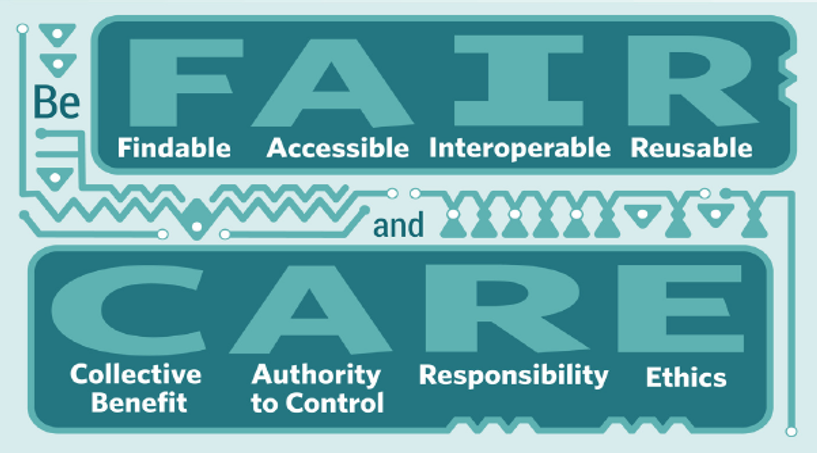 Image credit: GIDA
CARE Principles
The CARE principles, developed by the Global Indigenous Data Alliance (GIDA), reflect the crucial role of data in advancing Indigenous innovation and self-determination. They ensure that data movements, like the open data movement, whatever they advocate and pursue, respect the people and purpose behind the data.
FAIR Principles
In 2016, the FAIR Guiding Principles for scientific data management and stewardship were published in the open-access journal, Scientific Data. The authors intended to provide guidelines to improve the Findability, Accessibility, Interoperability, and Reuse of digital assets.
The FAIR principles refer to three types of entities: data, metadata, and infrastructure, and are set out in full on the GO FAIR website.